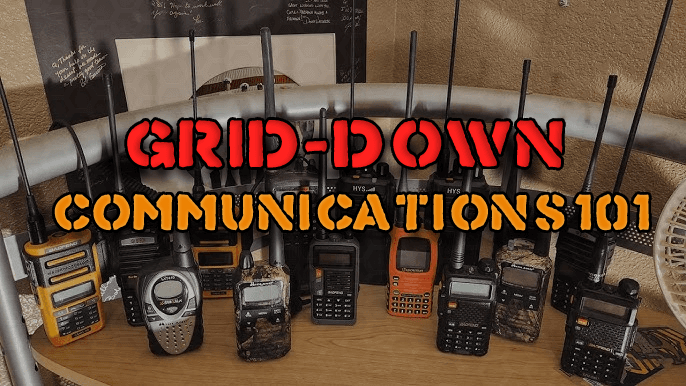
Grid-Down Communications 101: Your Guide to Staying in Touch When the Cell Towers are Silent
In every disaster movie, there's that moment. The power goes out, the hero picks up their cell phone, and the screen reads "NO SERVICE." It's a terrifyingly isolating feeling. All our modern magic, such as GPS, instant news, and calls to loved ones, vanishes in an instant.
For a prepper, communication isn't a luxury; it's a lifeline. It's how you gather intelligence, coordinate with your family or group, get help, and avoid walking into danger. Relying on the fragile cell grid as your only option is a critical failure point in any plan.
So, what's the alternative? Let's break down the real-world options for staying in touch when the grid goes dark. This isn't super technical radio-nerd talk; this is a straightforward guide for the rest of us.
Option 1: GMRS - The "Walkie-Talkie on Steroids"
GMRS, or General Mobile Radio Service, is the best starting point for 90% of preppers. Think of it as the familiar walkie-talkies you used as a kid, but with significantly more power and range.
- The Pros:
- Easy to Use: If you can use a walkie-talkie, you can use a GMRS radio. The learning curve is very low.
- Family-Friendly License: You need a license from the FCC, but it's not a test. You just apply online and pay a small fee. One license covers you and your entire immediate family for 10 years.
- Good Power & Range: Handhelds can be up to 5 watts, and vehicle-mounted radios can be up to 50 watts. You can reliably get a few miles between handhelds, and much more with bigger antennas or access to a "repeater" (a powerful antenna that re-broadcasts your signal over a wide area).
- The Cons:
- Range Limitations: Without a repeater, GMRS is still line-of-sight. Hills, buildings, and dense forests will reduce your range.
- Potential for Crowding: It's a popular service, so channels can be busy in a crisis, though there are privacy codes to help.
Bottom Line: For family communication, neighborhood watch, or convoy travel, GMRS is the perfect blend of simplicity, performance, and price.
Option 2: HAM Radio - The Gold Standard
HAM, or Amateur Radio, is the undisputed king of grid-down communications. It's a hobby for millions, but for preppers, it's the ultimate tool for gathering information and reaching out over vast distances without relying on any infrastructure.
- The Pros:
- Global Reach: Depending on your license level, radio, and atmospheric conditions, you can talk to people across the country or around the world.
- Massive Community: The HAM community is full of knowledgeable people who practice for emergencies. In a real disaster, they will be the ones running communications.
- Versatility: You can send voice, text data, and even images over HAM radio. It's a robust and flexible system.
- The Cons:
- License Requires a Test: You can't just buy a license. You have to study for and pass a multiple-choice test to get your Technician license (the entry-level).
- Steep Learning Curve: Getting the most out of HAM radio requires learning about frequencies, antennas, and procedures. It's a skill you have to develop.
Bottom Line: If you are serious about long-term preparedness and want the ability to gather intelligence from far away, getting your HAM license is one of the best skills you can possibly learn.
Option 3: Satellite Messengers - The "SOS" Button
What if you're alone in the middle of nowhere and need help *right now*? That's where satellite messengers (like a Garmin inReach or ZOLEO) come in. These devices don't talk to cell towers; they talk directly to satellites orbiting the Earth.
Think of a satellite messenger not as your primary communication tool, but as your last-ditch lifeline when all else fails.
- The Pros:
- Works Almost Anywhere: As long as you have a clear view of the sky, you can send a message.
- Dedicated SOS Feature: Most have a big SOS button that, when pressed, sends your exact GPS coordinates to an international emergency response center that will dispatch help.
- Two-Way Texting: You can send and receive short text messages to cell phones or email addresses.
- The Cons:
- Requires a Subscription: The device itself is expensive, and you MUST pay a monthly or annual subscription fee for it to work. No subscription = a useless brick.
- Relies on a Private Company: You are depending on a corporation (Garmin, Iridium, etc.) to keep their satellite network running. In a truly global SHTF scenario, this is not guaranteed.
Bottom Line: An excellent tool for anyone who travels in remote areas or wants a powerful, foolproof way to call for help. It's a fantastic layer of redundancy, but shouldn't be your only plan.
Your communication plan is just as important as your food, water, or security plan. Start small with a pair of GMRS radios for your family, and then consider getting your HAM license as your next big step. In a world of silence, the one who can still communicate has the ultimate advantage.